Physics-driven space combat that uses momentum as your weapon
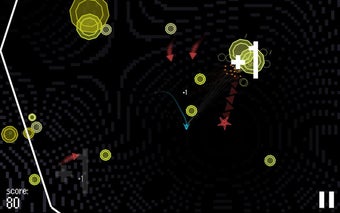
Particle Mace, by Andy Wallace, is a physics-based space combat game that replaces guns with momentum-focused melee. Players pilot a fragile ship that swings a cloud of tethered particles into enemies, using inertia and thrust to complete mission objectives across hazardous arenas. The iPhone release pairs more than 150 mission challenges, unlockable ships, and a survival leaderboard with a procedural backdrop and dynamic soundtrack. It targets fans of arcade classics and physics challenges seeking skillful, mission-driven mobile sessions.
What kind of game is Mace?
Mace reimagines classic arcade shooters as a physics puzzle in motion, trading conventional firing for momentum-based attacks. The core loop asks the player to survive, navigate, and strike by swinging a tethered cloud of particles into threats, so combat is a study in timing and spatial control. The design forces 'trying not to die' play: contact with hazards ends the run immediately, which frames every maneuver as consequential.
How do modes and ship choices shape play?
The iPhone build focuses on single-player missions, while other platforms include local multiplayer options, so session goals differ by platform. Ship selection matters because unlockable vessels change handling and particle behaviour, which shifts how players approach objectives. Survival mode exists for score chasing and leaderboard rivalry, giving a separate loop where endurance and deliberate pacing replace mission-based checkpoints as the prime reward.
What does the game look and sound like?
The visual design favors bright, abstracted shapes and a minimalist, retro-inspired style that echoes 1980s arcade icons without clutter. Backgrounds generate procedurally, giving each arena a slightly different look, while the soundtrack, composed by Nathaniel Chambers, adapts dynamically to play. Audio cues and crisp visual contrast make it easier to read momentum and particle arcs even when the screen fills with fast-moving elements.
Is it hard to get started and what keeps you returning?
Getting into the rhythm requires learning inertia and precise thrust control, because the mace responds to momentum rather than button-press damage. The mission set includes varied objectives, from timed survival to target counts, which unlock new challenges and ships over time. Critical reception highlights the satisfying physics feel, and a Metacritic score ofreflects praise for the tactile control that draws players back to master tricky maneuvers.
In summary, Mace rewards patient players who like skill-based arcade challenges
Mace is a demanding pick for players who enjoy mastering movement and high-stakes runs, a stance supported by anMetacritic reception. Consider that the iPhone version requires iOS 7.0 or later, which places it squarely on mobile hardware capable of stable physics simulation. For those who seek precision-based arcade tests rather than casual tap-and-forget sessions, it is a compelling mobile experience.
Pros
No-gun combat turns momentum into an offensive mechanic
Wide mission variety encourages different tactical approaches
Dynamic soundtrack and procedural backgrounds enhance atmosphere
Cons
Ship fragility produces repeated one-hit failures for new players
Single-player focus on iPhone limits local multiplayer options
Requires precise control, steep learning curve for casual users
Laws concerning the use of this software vary from country to country. We do not encourage or condone the use of this program if it is in violation of these laws. Softonic may receive a referral fee if you click or buy any of the products featured here.